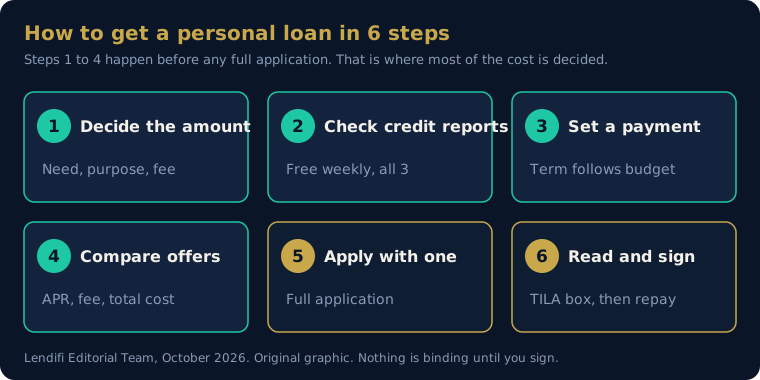
Step 1: Decide how much you need
Start with a number and a reason, not a lender. Write down exactly what the money is for and the dollar amount it takes. If you are paying off credit cards, list every balance and its APR so you know the real total. Borrowing extra "just in case" means paying interest on money you did not need.
Two things change the number you ask for:
- Origination fees. Many lenders take the fee out of the loan before the money is sent, so the deposit is smaller than the loan. Our guide on how much to borrow to cover an origination fee has the formula.
- Lender limits. Each lender sets its own minimum and maximum. See how much you can borrow with a personal loan for what drives that ceiling.
If the loan is for debt consolidation, run your balances through our Should I consolidate? calculator first. It shows whether a new loan would actually cost less than what you pay now, with the fee included.
Step 2: Check your credit reports
Lenders price a personal loan largely from your credit history, so look at what they will see before they see it. The Federal Trade Commission says all three nationwide credit bureaus have permanently extended a program that lets you check your report from each of them once a week for free at AnnualCreditReport.com, and that it is the only site authorized to fill orders for the free reports you are entitled to by law (FTC). The FTC also says to check before you apply for credit or a loan.
What to look for:
- Accounts you do not recognize, which can be a sign of identity theft.
- Late payments or balances that are wrong.
- Old addresses or names that do not match your application.
If something is wrong, dispute it with the bureau and with the business that reported it. A report is not a score, and we cannot tell you what score a lender will use or need. Each lender sets its own minimum. Our guide on what credit score you need for a personal loan covers how lenders look at it.
Step 3: Set a payment you can carry
Decide the most you can pay every month without new card balances creeping back in. Then let that number, not the lender, pick your term. A longer term lowers the payment and raises the total cost.
Stretching from 36 to 60 months cuts the payment by $109.70 a month and adds $1,389.36 in interest. The 12% rate is illustrative, not a quote. For context, the Federal Reserve's G.19 release of October 7, 2026 shows an average rate of 11.90% on 24-month personal loans at commercial banks for August 2026 (Federal Reserve G.19). Your rate could be higher or lower.
Want to see options before you start?
A few more questions, no obligation.
See what I qualify forStep 4: Compare several offers
"When I was clearing about $10,000 of credit card debt, what I wanted was several real offers in front of me at once, so I could look at them side by side and choose."
That is why comparing comes before applying in this guide, not after.
This is the step that decides what the loan costs. Get at least a few offers, then line them up on the same fields:
- APR, which includes the interest rate and most loan fees.
- Origination fee in dollars, and whether it comes out of the loan.
- Amount deposited, the cash that actually reaches you.
- Term and monthly payment.
- Total of payments, the full amount you will repay.
- Prepayment penalty, yes or no. Our guide on how to check for a prepayment penalty shows where it appears.
Our guide on how to compare personal loan offers side by side walks through three example offers with these fields filled in.
Rate checks are not all the same. Some lenders use a soft credit check to show you a rate, and others may run a hard check. Ask before you submit. The prequalification vs. hard pull guide explains the difference. One detail worth knowing: myFICO says FICO Scores give special rate-shopping treatment to mortgage, auto loan, and student loan inquiries (myFICO). Personal loans are not on that list, so save full applications for the lender you actually choose.
Include a credit union. The NCUA Board extended a temporary 18% interest rate ceiling on loans made by federal credit unions to September 10, 2027 (NCUA). You have to be eligible to join, and you can search for one with the federal credit union locator. State-chartered credit unions follow their own state's rules.
If a lender pushes you to sign the same day, or will not give you the APR and total cost in writing, slow down. Our personal loan scams and red flags guide lists the warning signs.
More lenders are ready to review your request
A few more questions, no obligation.
See what I qualify forStep 5: Apply with the lender you pick
Once one offer wins on total cost, apply with that lender. The formal application is where the lender verifies what you told it, and it usually means a hard inquiry on your credit.
Have these ready, since most lenders ask for some version of them (check the lender's own list):
- Government ID and your Social Security number.
- Proof of income, such as recent pay stubs, tax returns, or bank statements.
- Your address and housing payment.
- A checking account for the deposit and, if you want it, autopay.
- For consolidation, the account numbers and payoff amounts of the debts you are paying off.
Be exact. A rounded-up income can stall verification or change the offer. And never pay a fee to "unlock" or "guarantee" a loan before it is funded. That is the pattern of an advance-fee scam, not a real lender.
Step 6: Read the disclosure, sign, and repay
Before you are bound, the lender has to give you the Truth in Lending disclosures (12 CFR 1026.17). For a fixed-rate personal loan, that box shows (12 CFR 1026.18):
- Amount Financed: the credit provided to you or on your behalf. If it is below what you need, the loan is sized wrong.
- Finance Charge: the dollar cost of the credit, fees included.
- Annual Percentage Rate: the yearly cost of the credit.
- Total of Payments: everything you will repay if you pay as scheduled.
- Prepayment: a statement of whether you would pay a penalty for paying early.
Match each number to the offer you picked in step 4. If anything moved, ask why before you sign. Nothing is binding until you sign, and asking for time is a normal request.
After funding:
- If the loan pays off cards, confirm each card shows the payoff, and keep making card payments until it does.
- Set up autopay and put the payoff date on your calendar.
- Keep paid-off cards from filling back up. A loan only helps if the old balances stay at zero.
When you are ready to compare, start on the Lendifi personal loans page. New to the basics? Read what a personal loan is first. Rebuilding credit? See how to get a personal loan with bad credit.
More lenders are ready to review your request
A few more questions, no obligation.
See what I qualify forSources: Free weekly credit reports, Federal Trade Commission. Rate-shopping treatment of inquiries, myFICO. Average personal loan rate, Federal Reserve G.19 (released October 7, 2026). Federal credit union rate ceiling, NCUA (February 6, 2026). Disclosure timing and content, 12 CFR 1026.17 and 12 CFR 1026.18. Example figures are illustrative calculations by Lendifi, not real lender offers.
Frequently asked questions
Lendifi is operated by Apex Lead Group LLC. Lendifi is not a lender and does not make loans or credit decisions. We are an advertising-supported comparison service, and some links on this page are affiliate links through which we may earn a commission at no cost to you. Any rates, payments, or savings figures shown are estimates based on average market data and are not guarantees of approval or financing. Actual rates and terms are determined by the lender based on your full credit profile. See our Ad Disclosure for details.