Check the terms before you commit
A few more questions, no obligation.
See what I qualify forWhat a prepayment penalty is
A prepayment penalty is a charge for paying off all or part of a loan before it is due. The Consumer Financial Protection Bureau describes it as a fee some lenders charge if you pay off a loan early, and advises reading the fine print to understand exactly when you would pay and how much (CFPB). The CFPB page is written about mortgages, but the idea is the same for a personal loan: the lender priced the loan expecting a stream of interest, and an early payoff ends that stream.
Many personal loan lenders do not charge one. That is exactly why it is easy to skip the check. The founder's story is the typical one. He had a fixed payment, he paid on schedule, and the question of early payoff never came up. If it had, if a bonus or a tax refund had made it possible to clear the balance early, he would have found out from the agreement whether that clause was there. He would have been reading it for the first time.
Paying a loan off early is one of the most reliable ways to cut what it costs you, because interest stops accruing on money you no longer owe. A penalty does not remove that benefit, but it can shrink it, and you want to know which kind of loan you have before you choose it.
Where to find it in your loan papers
You do not have to search the whole contract. Federal Truth in Lending rules require the lender to tell you directly.
- The Truth in Lending disclosure box. For a loan with interest charged on the unpaid balance, which is how most personal loans work, the lender must state whether or not a charge may be imposed for paying all or part of the principal early (12 CFR 1026.18, paragraph k).
- It must be a definite statement. The official commentary says the creditor must give a definitive statement of whether or not a penalty will be imposed. The absence of a penalty cannot simply be inferred from silence; the lender must say that prepayment will not result in a penalty.
- The contract reference. The disclosures must also tell you to look at your contract documents for details about prepayment rebates and penalties (12 CFR 1026.18, paragraph p). That points you to the section to read.
So the check is simple. Find the line in the disclosure that says Prepayment, read whether it says you may or will not have to pay a penalty, and if it says you may, find the matching section of the agreement and read how the charge is calculated.
One caution on timing. These disclosures must come before you sign, but for an unsecured loan they are not required at any particular time before that (12 CFR 1026.17, paragraph b and commentary). Ask for the disclosure or a sample agreement as early as you can, so you are not reading the prepayment line for the first time at the table.
Check the terms before you commit
Compare estimated rates and terms from multiple lenders in about a minute.
Compare loans now →What a penalty would cost: a worked example
Here is an illustrative example we calculated. It is not a real lender's terms.
Say you borrow $10,000 at a 14% fixed rate for 48 months. The payment is $273.26 a month, and if you make every payment you will pay $13,116.71 in total, or $3,116.71 in interest. After 24 payments, you come into enough money to pay it off. Your remaining balance is $5,691.49.
If you kept paying on schedule, the last 24 payments would add up to $6,558.35. Paying the balance now instead saves you $866.87 in interest. Now add a penalty, shown here as a percent of the remaining balance:
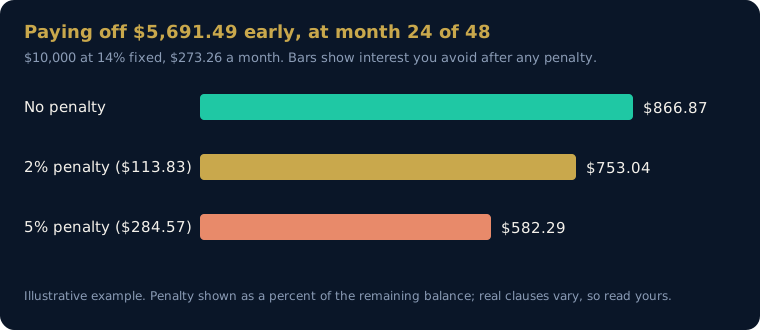
In this example, paying early still comes out ahead even with a penalty. That will not always be true. A penalty on a small remaining balance late in the loan can eat most of what you would save, and some clauses are structured differently. The point is not that penalties are always ruinous. The point is that you want to know the formula before you sign, so early payoff is a decision you can make with real numbers.
For the full picture of what a loan costs over its life, including fees, see the true cost of a personal loan.
Forms a penalty can take
A prepayment penalty is not always labeled as a fee on a single line. The Regulation Z commentary gives examples of charges that count as prepayment penalties for disclosure purposes (12 CFR 1026.18, commentary to paragraph k(1)), including:
- Interest charged as if the balance were still owed for some period after you pay in full.
- A waived fee that comes back. For example, an origination fee or closing cost that the lender waives on the condition that you do not pay early, then charges if you do.
- A minimum finance charge in a simple interest loan.
The same commentary says the origination fee you paid upfront is not, by itself, a prepayment penalty. You do not get it back when you pay early, and it does not have to be disclosed as a penalty. That matters when you are comparing loans: a large upfront fee makes early payoff less valuable even on a loan with no penalty at all. Our guide to personal loan fees covers how that fee works.
Questions to ask before you sign
The founder's check would have taken thirty seconds. Here is what it looks like:
- Is there any charge for paying this loan off early, in full or in part? Ask for the answer in writing, or point to the line in the disclosure.
- If yes, how is it calculated, and does it end after a certain number of months? Get the formula, not a description.
- Are any fees waived on the condition that I keep the loan for a set time? This is the version that is easiest to miss.
- Can I make extra payments toward principal without a charge? Partial prepayment is the most common way people save, and the disclosure covers it too.
- Where in the agreement is this written? A section number lets you read it at home before signing day.
Put the answer on your comparison sheet next to APR, fee, and total cost. If you are lining up several offers, our guide on how to compare personal loan offers side by side shows the full checklist. Two loans with the same APR are not equal if only one lets you pay it off early for free.
Compare offers with the fine print in view
See estimated APRs and terms from multiple lenders side by side.
Compare loans now →If your loan already has one
If you already signed and the disclosure says a penalty may apply, it is not necessarily a reason to panic or to refinance. Read the section that explains how the charge works and run your own version of the example above: remaining scheduled payments, minus the payoff balance, minus the penalty. If the result is still positive, paying early still saves money. If it is close to zero, keeping the loan and paying on schedule may be just as good.
If you are not sure how the clause applies, ask the lender in writing for a payoff quote that shows any prepayment charge as a separate line. That one document answers the question with real numbers.
The founder got lucky. You do not need luck, only one line of the disclosure read before you sign. When you are ready to compare loans, start on the Lendifi personal loans page.
Sources: Prepayment disclosure, contract reference, and examples of prepayment penalties, 12 CFR 1026.18 and official commentary. Disclosure timing, 12 CFR 1026.17. Definition of a prepayment penalty, CFPB, What is a prepayment penalty?. Example figures are illustrative calculations by Lendifi, not real lender terms.
Frequently asked questions
If your loan already has a prepayment penalty, read the disclosure carefully before you pay ahead. If it does not, the next question is how to apply extra payments so they actually cut interest: see how to pay off a personal loan faster.
Lendifi is operated by Apex Lead Group LLC. Lendifi is not a lender and does not make loans or credit decisions. We are an advertising-supported comparison service, and some links on this page are affiliate links through which we may earn a commission at no cost to you. Any rates, payments, or savings figures shown are estimates based on average market data and are not guarantees of approval or financing. Actual rates and terms are determined by the lender based on your full credit profile. See our Ad Disclosure for details.