Size the loan before you apply
A few more questions, no obligation.
See what I qualify forIs the fee taken out of your loan?
Usually, yes. Origination fees are most commonly taken out of the loan amount, and in other cases may be added to the total you borrow (Bankrate). The official commentary to Regulation Z shows three ways a lender can collect a loan fee (12 CFR 1026.18, commentary to paragraph b(3)):
- Withheld from the money you receive. In the commentary's example, a $2,500 note with a $40 fee advances $2,460.
- Added to the balance. The note becomes $2,540 and the borrower receives $2,500.
- Paid separately at closing, in cash or by check. That is less common for personal loans, and a lender that asks you to send a fee before the loan is funded is a scam red flag (Bankrate; see our guide to personal loan scams).
Either way, the fee is a cost of credit. Regulation Z counts loan fees in the finance charge (12 CFR 1026.4) and treats a fee withheld from the proceeds as a prepaid finance charge (12 CFR 1026.2). That is why it shows up in the APR and shrinks the Amount Financed on your disclosure.
The withheld version is the one that surprises people: you repay the full loan, with interest on all of it, while a smaller number lands in your account. If you need a specific amount in hand, you have to borrow more.
How much to borrow: the formula
When the fee is a percentage of the loan and is withheld from it, the amount to borrow is:
Loan amount = amount you need ÷ (1 − fee rate). For a 5% fee, divide by 0.95. For an 8% fee, divide by 0.92. Round up to the next whole dollar.
Worked examples:
- Need $5,000 with a 5% fee: borrow $5,264. The fee is $263.20 and $5,000.80 is deposited.
- Need $15,000 with an 8% fee: borrow $16,305. The fee is $1,304.40 and $15,000.60 is deposited.
- Need $20,000 with a 3% fee: borrow $20,619. The fee is $618.57 and $20,000.43 is deposited.
If a lender only offers certain loan amounts, round up to the next one it allows and recheck the deposit. If the fee is added to the balance instead, you do not need the formula, but you still repay the fee with interest.
Worked example: netting $10,000
What it takes to have $10,000 deposited. Fee rates are illustrative, not quotes from any lender.
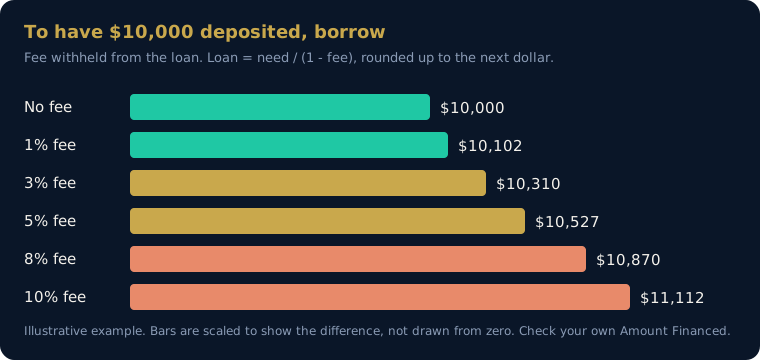
Each loan deposits just over $10,000 (between $10,000.40 and $10,000.98) because of rounding up. Notice the fee is larger than the simple percentage of $10,000 in every row. At 5% it is $526.35, not $500, because it is charged on the whole $10,527.
The shortcut that leaves you short
The common shortcut is adding the fee percentage: 5% of $10,000 is $500, so borrow $10,500. Close, but the fee is also charged on the extra $500.
Honestly, the shortcut is not the real danger; in these examples it misses by $100 or less. The real miss is not adjusting at all: borrow $10,000 at a 5% fee and $9,500 is deposited, $500 short. If that money was meant for specific card balances, the last card does not get paid.
Add-on fees work differently. If a lender adds a 5% fee on $10,000 to your balance, you owe $10,500 and receive $10,000. Withheld from a grossed-up loan, you owe $10,527 with a $526.35 fee, $26.35 more in fees. Ask which way your lender calculates it.
What covering the fee really costs
Borrowing extra solves the shortfall, but it is not free. An example at 12% over 36 months, 5% fee withheld:
Covering the fee puts $500.65 more in your account and costs $630.36 more in payments, so the extra cash costs $129.71 in interest. On the money you actually receive, the APR is 15.61%, not 12%. Same rate and term, by fee:
The 12% loan with a 5% fee works out to 15.61% APR. A loan with no fee beats it at any rate below that. In our example, a no-fee loan of $10,000 at 15% costs $12,479.40 in total, $108.00 less than the fee loan. At 16% it costs $12,656.52, which is $69.12 more.
That is the honest finding here: sometimes the cheaper move is not borrowing around the fee but choosing a different loan. Our guide to personal loan fees covers the other charges that can sit next to an origination fee, and the true cost of a personal loan adds them all up.
More lenders are ready to review your request
A few more questions, no obligation.
See what I qualify forWhen not to borrow extra
Grossing up is right when you need an exact amount and the fee loan is still your best option. Otherwise:
- Compare against a no-fee offer first. If a no-fee lender quotes a rate under the fee loan's APR for the same term, the gross-up question disappears.
- Cover a small gap from savings. Borrowing the extra $500.65 cost $129.71 in interest. If savings can cover it without draining your emergency cushion, that is cheaper.
- Use the real number, not a round one. Paying off cards? Your target is each card's payoff amount, so ask each issuer for one. If the lender pays creditors directly, those payments should appear in the itemization as amounts paid to others on your behalf (12 CFR 1026.18, paragraph c).
- Skip the cushion "to be safe." Every extra dollar carries the fee and interest, and a larger request may be priced or approved differently.
Consolidating card debt? Our debt consolidation calculator has an origination fee input, so you can see whether consolidating still saves money with the fee included. The debt consolidation page covers the rest of that decision.
How to check the number before you sign
The disclosures tell you whether the loan is sized right.
- Amount Financed. The Truth in Lending disclosure must show it, with a description like the amount of credit provided to you or on your behalf (12 CFR 1026.18, paragraph b). If it is below what you need, the loan is sized wrong.
- The itemization. The lender must give you a written itemization of the Amount Financed or tell you that you can request one. It shows money paid to you, money paid to others for you, and the prepaid finance charge (12 CFR 1026.18, paragraph c). Ask for it.
- Timing. These disclosures must come before the loan is finalized (12 CFR 1026.17), which can be close to signing. Ask at the estimate stage: what exact dollar figure lands in my account, and is the fee withheld or added to my balance?
The founder never got to ask that early, because he did not see the fee until the signing table. By then he had told himself the problem was solved, felt too far in to say anything, and signed. Nothing is binding until you sign, and asking a lender to resize the loan, or to give you time to think, is a normal request. Lining up several offers? Our guide on how to compare personal loan offers side by side puts the deposit next to APR and total cost. When you are ready, start on the Lendifi personal loans page.
More lenders are ready to review your request
A few more questions, no obligation.
See what I qualify forSources: Fee collection methods, Amount Financed, itemization, and contract mechanics, 12 CFR 1026.18 and official commentary. Loan fees in the finance charge, 12 CFR 1026.4. Prepaid finance charge definition, 12 CFR 1026.2. Disclosure timing, 12 CFR 1026.17. How fees are commonly collected, Bankrate. Example figures are illustrative calculations by Lendifi, not real lender terms.
Frequently asked questions
Lendifi is operated by Apex Lead Group LLC. Lendifi is not a lender and does not make loans or credit decisions. We are an advertising-supported comparison service, and some links on this page are affiliate links through which we may earn a commission at no cost to you. Any rates, payments, or savings figures shown are estimates based on average market data and are not guarantees of approval or financing. Actual rates and terms are determined by the lender based on your full credit profile. See our Ad Disclosure for details.