More lenders are ready to review your request
A few more questions, no obligation.
See what I qualify forWhy one offer at a time fails
Most people shop for a loan the way the founder did: apply with one lender, hear a number, then decide whether that number feels okay. The problem is that a single offer has nothing to be measured against. A 12% rate sounds fine or terrible depending on what else is available, and you cannot know which until you see the alternatives.
His situation was common. He was making credit card payments every month and the balance barely moved. A fixed-rate personal loan was the right tool for him, and it worked: he paid the cards off and then paid the loan down on a schedule. But the process of choosing the loan was harder than it needed to be, because every lender presented its offer in its own format, with its own emphasis, and usually with the monthly payment up front.
Comparison only works when every offer is translated into the same handful of fields. Once you do that, the best offer is usually obvious, and it is often not the one with the lowest advertised rate.
The seven fields to line up
For every offer, write down the same seven things. If a lender will not give you one of them, that is information too.
- Loan amount. The face amount you will owe. Keep it the same across offers or the comparison is meaningless.
- Amount deposited to you. What actually lands in your account after any fee is taken out. Federal Truth in Lending rules call this the amount financed (12 CFR 1026.18, paragraph b).
- Interest rate. What is charged on the balance. Useful, but not enough on its own.
- APR. The cost of credit as a yearly rate, which folds in charges such as loan fees. Lenders must disclose it under 12 CFR 1026.18, paragraph e, and loan fees count toward the finance charge under 12 CFR 1026.4, paragraph b(3). This is the single best number for comparing offers with the same term.
- Origination fee, in dollars. Percentages stay abstract. Ask for the dollar figure.
- Term and monthly payment. How many months, and what each payment is. A lower payment usually means a longer term, not a cheaper loan.
- Total cost. All payments added together, minus the amount deposited to you. This is the number that answers the real question: what does this money cost me?
Two more items belong at the bottom of the sheet: whether there is a prepayment penalty, and whether the rate is fixed. Both should be a simple yes or no in the written terms.
A worked example: three offers
Here are three illustrative offers for the same $10,000 request. These are example numbers we calculated, not real lender quotes, but the pattern is one you will see when you compare real offers.
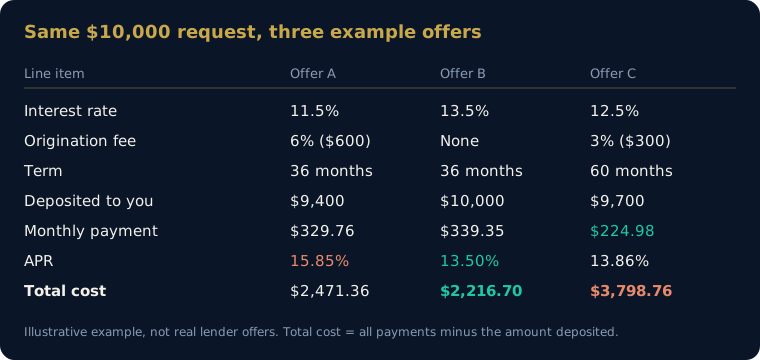
Offer A has the lowest rate and the worst APR. The $600 fee comes out before you see the money, so you receive $9,400 but repay $10,000 plus interest. Over 36 payments of $329.76 you pay $11,871.36, which is $2,471.36 more than you received.
Offer C has the lowest monthly payment and the highest total cost. At $224.98 a month it feels easiest, but 60 payments add up to $13,498.76. Subtract the $9,700 deposited and the loan costs $3,798.76, about $1,580 more than Offer B. Its APR looks close to B because APR is a yearly rate; the extra two years of interest only show up in total cost.
Offer B looks the most expensive and is the cheapest. The 13.5% headline rate is the highest of the three, but there is no fee, you receive the full $10,000, and the total cost is $2,216.70.
That is the whole case for side by side comparison. In a sales conversation, Offer A would be pitched on its rate and Offer C on its payment. Only the table shows that B wins. For more on how the rate and the APR relate, see how personal loan rates and APR work.
More lenders are ready to review your request
A few more questions, no obligation.
See what I qualify forThe fee you only see at signing
The founder's own loan had an origination fee. He does not remember the percentage. What he remembers is that he did not notice it until he was at the signing table, with the papers in front of him and the decision already made in his head. He signed anyway.
That is not unusual, and the rules allow it to happen. Under Regulation Z, the creditor must give the Truth in Lending disclosures before consummation, but for an unsecured personal loan those disclosures do not have to arrive at any particular time before that point (12 CFR 1026.17, paragraph b and its official commentary). In practice, the clearest statement of your fee can show up at the same moment you are expected to sign.
The fix is to get the fee before you are emotionally committed. When you prequalify or receive an estimate, ask two questions and write the answers on your comparison sheet:
- What is the origination fee as a dollar amount?
- If I borrow this amount, exactly how much will be deposited to my account?
If the deposit is less than you need, the gap has to come from somewhere. Our guide to personal loan fees walks through how to size a loan when the fee comes out of the proceeds.
How to build your own comparison
You do not need software. A sheet of paper with three columns works. The steps:
- Pick one loan amount and one target term. If you want 36 months, ask every lender for a 36 month quote, even if they suggest something else. You can add a longer term as a separate column later.
- Prequalify with several lenders in a short window. Many lenders offer prequalification with a soft inquiry. Lender practices differ, so confirm with each lender how it checks credit before you apply. Our guide to prequalification versus a hard pull explains the difference.
- Fill in all seven fields for each offer. Leave nothing blank. A blank is a question to send back to the lender.
- Compute total cost yourself. Monthly payment times number of payments, minus the amount deposited. It takes a minute and it is the number lenders rarely lead with.
- Rank by total cost at your chosen term, then sanity check the payment. The cheapest loan is only right if you can comfortably make the payment every month.
- Ask for the full agreement before signing day. Read the fee, the payment schedule, and the prepayment section at home, not at the table.
If the loan is for paying off credit cards, run the numbers on whether consolidating beats your current plan at all with the should I consolidate calculator. A loan can be the cheapest on your sheet and still not beat paying the cards down directly.
More lenders are ready to review your request
A few more questions, no obligation.
See what I qualify forWhen to walk away from an offer
While he was shopping, the founder dealt with a few lenders whose sales pressure felt aggressive enough that he walked away. They were most likely legitimate lenders, not scammers. The pressure was still a reason to leave, because a lender pushing for a fast signature is working against the one thing a comparison needs, which is time.
A few signals that should make you pause or walk:
- The lender will only quote a monthly payment and avoids giving the APR or total cost.
- You are told the offer disappears unless you sign today.
- The fee is described vaguely, or only as a percentage, after you have asked for dollars.
- You are asked to pay anything before the loan is funded. That is the pattern of an advance fee scam. See personal loan scams and red flags.
Nothing is binding until you sign. Being far along in a process is not a reason to accept a term you would have rejected at the start. That is the lesson the founder took from his own signing table, and it is why Lendifi exists: to put several offers in front of you at once so the comparison happens before the pressure does. You can start on the Lendifi personal loans page.
Sources: Truth in Lending disclosure content, 12 CFR 1026.18 (amount financed, finance charge, APR, total of payments, prepayment). Finance charge definition including loan fees, 12 CFR 1026.4. Timing of closed-end disclosures, 12 CFR 1026.17. Example figures are illustrative calculations by Lendifi, not real lender offers.
Frequently asked questions
Lendifi is operated by Apex Lead Group LLC. Lendifi is not a lender and does not make loans or credit decisions. We are an advertising-supported comparison service, and some links on this page are affiliate links through which we may earn a commission at no cost to you. Any rates, payments, or savings figures shown are estimates based on average market data and are not guarantees of approval or financing. Actual rates and terms are determined by the lender based on your full credit profile. See our Ad Disclosure for details.