The short answer
Several large lenders advertise funding the same business day or the next one after you are approved and sign, with conditions we cover below. A bank or credit union can take longer, especially if you are not yet a member. The legal outer limit for the decision itself is 30 days after the lender has a completed application, under federal Regulation B (12 CFR 1002.9).
Those ranges hide the real question, which is where the hours actually go. Here is the whole process in five stages.
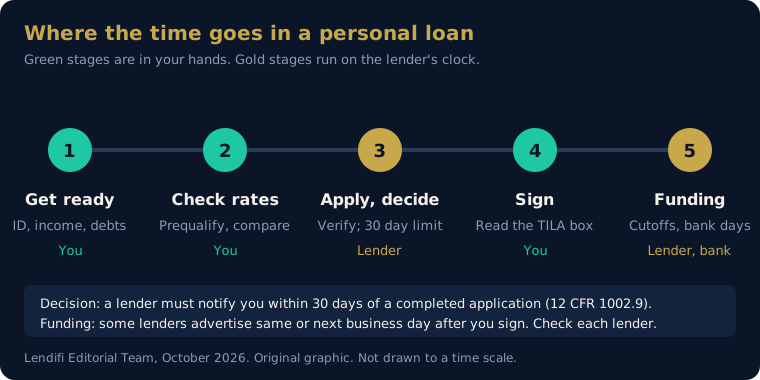
Stage 1: Getting ready (you control this)
This is the stage most people skip, and it is the one that most often causes delays later. Before you check a single rate, gather:
- A government ID and your Social Security number.
- Recent proof of income, such as pay stubs, tax returns if you are self-employed, or benefit letters.
- Your current address history and your employer's contact details.
- The exact amount you need. If you are paying off cards, have each balance and account number ready.
It also helps to pull your free credit reports and fix anything wrong before a lender sees it. A mismatch between your application and your credit file is one of the most common reasons a lender asks for more documents. If you are still deciding how much to borrow, our guide on how to get a personal loan walks through sizing the loan first.
Stage 2: Checking rates and comparing
Many lenders let you prequalify: you share basic details and see an estimated rate before you formally apply. Lenders describe these checks in their own terms, so read how each one says it pulls your credit. Our explainer on prequalification vs. a hard pull covers the difference.
Each prequalification form usually takes minutes. Comparing three or four takes an evening, and that evening is where most of the savings in this whole process come from. Line up APR, total repayment, origination fee in dollars, and monthly payment. Our guide to comparing personal loan offers shows how.
Want to see options while you read?
A few more questions, no obligation.
See what I qualify forStage 3: The full application and decision
Once you choose a lender, you submit a full application. This is when the lender verifies your identity and income and usually runs a full credit check. When everything matches, many online lenders can decide quickly. A request for more documents restarts part of the clock.
The law sets an outer limit. Regulation B says a creditor must notify you of action taken within 30 days after receiving a completed application, whether it approves you, makes a counteroffer, or declines. If the application is incomplete, the lender has 30 days to either decide or tell you what is missing (12 CFR 1002.9). If a lender goes quiet for weeks, ask in writing what it still needs.
Stage 4: Signing and funding
After approval you get the loan agreement and the federal Truth in Lending disclosure. Read the APR, finance charge, total of payments, and any fee before you sign. Then the money moves, usually by direct deposit to your bank. Here is how three lenders describe their timing on their own pages, copied October 27, 2026:
- SoFi says most borrowers receive funds the same day when the loan is approved and the agreement is signed by 5:30 PM ET on a business day, and that it does not guarantee timing.
- Discover says funds can be sent as early as the next business day after acceptance.
- Alliant Credit Union says it typically deposits an approved loan the same day, but you must have been a member for at least 90 days to apply.
Notice the conditions: business days, cutoff times, and membership. Sign at 6 PM on a Friday and "same day" can become Monday or Tuesday. For a debt consolidation loan, some lenders pay your card issuers directly, which adds its own posting time; our guide on how long debt consolidation takes covers that part.
How the lender type changes the clock
- Online lenders are built for speed: online forms, automated checks, and direct deposit. They tend to be fastest when your documents match.
- Banks may move quickly for existing customers whose income they can already see, and more slowly for new ones.
- Credit unions can be among the cheapest options, since federal credit unions are held to an 18% rate ceiling that the NCUA Board extended through September 10, 2027 (NCUA). The tradeoff is membership. Some require it before you apply, and Alliant, above, requires 90 days. If a credit union is your plan, join early. The federal credit union locator helps you find one.
More lenders are ready to review your request
A few more questions, no obligation.
See what I qualify forWhat slows a loan down
- Mismatched details. A different address on your ID and your credit file, or income that does not match your pay stubs.
- Self-employment or irregular income. Expect a request for tax returns or bank statements.
- A credit freeze. If you froze your credit files, the lender cannot pull them until you lift the freeze.
- Missing the funding cutoff. Signing after a lender's daily cutoff, or on a weekend or holiday, adds business days.
- A co-applicant. Two people means two sets of documents to verify.
When faster costs more
Speed has a price when it replaces comparison. Say you need $10,000 over 36 months. The first lender you try offers 20% APR. A second lender, found with one more evening of comparing, offers 14%. These are illustrative figures computed by Lendifi, not offers.
That is $29.86 a month and $1,074.96 over the loan, for one extra evening. If the need is a true emergency, speed may matter more. But a lender that says an offer expires tonight, or that you must decide on the phone, is using time pressure against you. Our page on personal loan scams and red flags covers that tactic, and any request for a fee before you get a loan is a reason to stop. The basics of loan types and costs are on our personal loans page.
A note from our founder
When I paid off about $10,000 of credit card debt with a fixed-rate personal loan, what I wanted most was several real offers side by side. Not one quick yes, but a few numbers I could compare on the same terms.
Getting there took me longer than the loan itself did to fund. I would do it the same way again: spend the extra evening up front, then move fast once the choice is clear.
More lenders are ready to review your request
A few more questions, no obligation.
See what I qualify forFrequently asked questions
Lendifi is operated by Apex Lead Group LLC. Lendifi is not a lender and does not make loans or credit decisions. We are an advertising-supported comparison service, and some links on this page are affiliate links through which we may earn a commission at no cost to you. Any rates, payments, or savings figures shown are estimates based on average market data and are not guarantees of approval or financing. Actual rates and terms are determined by the lender based on your full credit profile. See our Ad Disclosure for details.