Why a license check matters
Most non-bank lenders that make consumer loans need a state license or registration where you live. A license means a state regulator knows who the company is, examines it, and takes complaints about it. It does not mean the loan is a good deal, but lending without one can change your rights.
The Consumer Financial Protection Bureau says to verify a lender with your state regulator or attorney general, and notes that in some states, a loan made by an unlicensed business may be void, so the lender may not have the right to collect it (CFPB). That page is about payday loans, but the habit applies to any lender. Illinois goes further: a non-bank loan over a 36% APR is null and void under its Predatory Loan Prevention Act (815 ILCS 123).
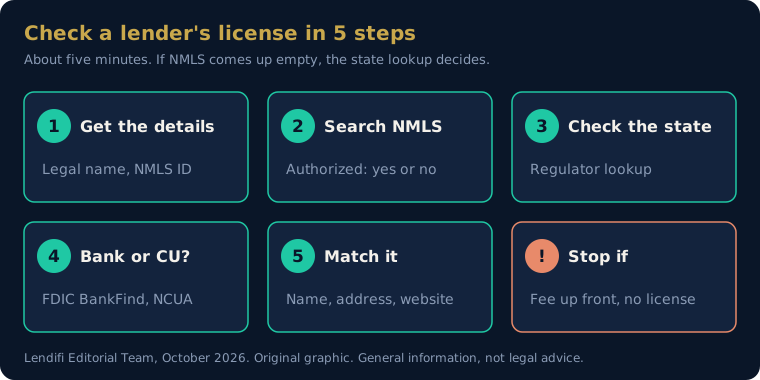
Before you search: get three things
- The exact legal name. Brand names and legal names often differ. Look in the website footer, terms of use, or loan documents.
- An NMLS ID, if it has one. Many licensed lenders print it in the footer.
- The state license number and address. These let you confirm you have the right company and not a copycat.
A real lender will give you all three. If a company dodges the question, you have learned something already.
Step by step on NMLS Consumer Access
NMLS Consumer Access is a free public search of companies and individuals licensed or registered through the Nationwide Multistate Licensing System. It started with mortgage licensing and now includes consumer finance and debt companies in many states (NMLS).
- Search by the NMLS ID or the company name.
- Open the company record and find the license for your state.
- Check the "Authorized to Conduct Business" flag. NMLS shows it as yes for an active license and no for an inactive one.
- Compare the name, other trade names, address, and website on the record with the company you are dealing with.
- Look for any state regulatory actions posted to the record.
Two limits matter. NMLS shows only licenses in a reportable status, so a pending application will not appear. And not every state uses NMLS for every license type, so a missing record does not prove a company is unlicensed. That is when you go to the state.
Want to compare lenders you can check?
A few more questions, no obligation.
See what I qualify forWhen NMLS is not the whole story: state lookups
Here is where to check in the states we cover in our guides, from each regulator's own pages:
- Utah: the Department of Financial Institutions says consumer lenders file a Consumer Credit Notification through NMLS, which you can verify on NMLS Consumer Access (Utah DFI). See our Utah guide.
- Texas: the Office of Consumer Credit Commissioner licenses non-depository lenders charging more than 10% (OCCC). Check NMLS, then the OCCC's older records. See our Texas guide.
- Florida: the Office of Financial Regulation's Verify a License page leads to its license search. See our Florida guide.
- California: the Department of Financial Protection and Innovation keeps a Regulated Entities List. See our California guide.
- Pennsylvania: consumer discount companies apply through the DoBS Portal, not NMLS (DoBS), so search the PA Financial Institutions Search or call 1 (800) PA-BANKS. See our Pennsylvania DoBS.
- Illinois: use IDFPR's DFI License Lookup and pick the license type, such as Consumer Installment Lenders. See our IDFPR.
For any other state, search for your state's department of financial institutions or banking department and look for a license lookup. Lendifi's own state disclosures are on our licenses page.
Banks and credit unions
Banks and credit unions are chartered and supervised differently, so they usually will not show up in a state consumer lender search. Confirm a bank on FDIC BankFind and a credit union on the NCUA credit union locator. Make sure the website you are on actually belongs to that institution, since copycat sites borrow real bank names.
Red flags in what you find
- The name almost matches. One letter off, a different city, or a different web address. Scammers copy real lenders.
- The license type does not fit. A license for check cashing or money transmission is not a license to make installment loans.
- The status is inactive, expired, or revoked. On NMLS, the authorization flag will say no.
- "State law does not apply to us." Treat that line as a reason to call your regulator before you sign.
- A fee before the loan. A demand to pay up front, by wire, gift card, or app, before you receive any money is the classic advance-fee scam. See personal loan scams and red flags.
More lenders are ready to review your request
A few more questions, no obligation.
See what I qualify forIf you already borrowed from an unlicensed lender
Finding out after the fact is stressful, but you have options. First, keep everything: the loan agreement, the Truth in Lending disclosure, every payment record, and any texts or emails. Screenshots of the website help too, since pages change.
Next, contact your state financial regulator and ask two questions: was this company required to hold a license for my loan, and what are my rights if it did not? Rules differ by state. As the CFPB notes above, in some states such a loan may be void. Whether that applies to you depends on your state and your loan, which is why the regulator, not a forum post, is the right first call.
Do not simply stop paying on your own without advice, and be careful of any "debt relief" company that contacts you promising to cancel the loan for a fee. Check that company's license the same way.
Checking a company that offers debt help
Debt management and debt settlement companies are licensed separately from lenders in many states. Texas requires debt management providers to register with the OCCC. Pennsylvania licenses them through DoBS and requires them to use NMLS. Illinois licenses them through IDFPR. Use the same steps: legal name, license number, state lookup. If you are deciding between a loan and a plan, start with our debt consolidation loans page or our comparison of debt consolidation vs. a debt management plan. For loan basics, see our personal loans page.
A note from our founder
When I paid off about $10,000 of credit card debt with a fixed-rate personal loan, I walked away from lenders whose sales pressure felt aggressive. I did not run a license search on every one of them. The pressure was enough of a signal.
Looking back, a five minute license check would have given me a cleaner reason to say no, or yes. That is why this guide exists.
More lenders are ready to review your request
A few more questions, no obligation.
See what I qualify forFrequently asked questions
Lendifi is operated by Apex Lead Group LLC. Lendifi is not a lender and does not make loans or credit decisions. We are an advertising-supported comparison service, and some links on this page are affiliate links through which we may earn a commission at no cost to you. Any rates, payments, or savings figures shown are estimates based on average market data and are not guarantees of approval or financing. Actual rates and terms are determined by the lender based on your full credit profile. See our Ad Disclosure for details.