"I carried about $10,000 on credit cards. I made payments every month, and the balance barely moved. A fixed-rate personal loan is what finally cleared it."
The numbers below are the math behind that feeling. They are worked examples, not the founder's actual balances or rates.
The short answer, in one table
All rows start at a $10,000 balance with no new charges. The card rows use a 22.36% APR, the average rate on credit card accounts assessed interest at commercial banks for August 2026 in the Federal Reserve's G.19 release of October 7, 2026 (Federal Reserve G.19).
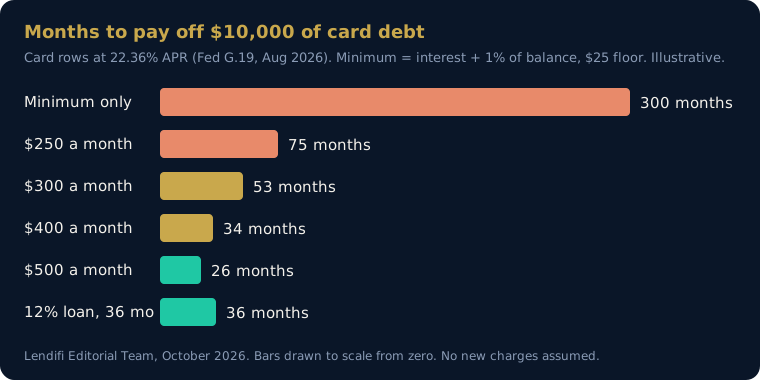
The loan row is illustrative, not a quote, and it assumes no origination fee. We add a fee further down.
Why the balance barely moves
At 22.36% APR, a $10,000 balance builds $186.33 of interest in the first month. Under our example minimum, the first payment is $286.33. Only $100.00 of it reduces what you owe. The rest pays for the month that just happened.
Keep paying the minimum for a year and the balance is still $8,863.85. A fixed $250 payment does even less at the start: $63.67 of the first payment goes to principal, and after 12 months you still owe $9,152.64. That is the feeling the founder describes. You are paying every month, and the number on the statement hardly changes.
The fix is not effort. It is either a bigger share of each payment going to principal, which means a higher payment, or a lower rate, which means less of each payment lost to interest.
The minimum payment path
Card issuers set their own minimum payment formulas, and yours is in your cardholder agreement. For this guide we used an illustrative formula: the month's interest plus 1% of the balance, with a $25 floor. Because the minimum shrinks as the balance shrinks, the payoff drags on.
In this example you repay $27,557.95 for a $10,000 balance. Our minimum payment calculator runs the same kind of math on your own balance and rate. Our guide to reading your minimum payment calculator results explains each number it shows.
Check your own numbers
A few more questions, no obligation.
See what I qualify forPaying a fixed amount on the card
Picking a fixed payment and never lowering it is the simplest upgrade. The difference between $250 and $500 a month is 49 months and $5,893.12 of interest.
To clear $10,000 on the card in exactly 3 years at 22.36%, the payment is $383.77 a month, with $3,815.72 of interest. Hold that number. It is the one to beat with a loan.
A fixed payment only works if the card stops growing. New purchases on the same card push the payoff date back every month.
The fixed-rate loan path
A debt consolidation loan, which is a fixed-rate personal loan used to pay off other debt, replaces the card balance with one fixed payment and a fixed end date. It helps when the loan's APR is clearly lower than the card's.
Three things to notice:
- The rate does the work. Same 36 months, and the 12% loan costs $1,858.68 less in interest than the card.
- Fees matter. If a 5% origination fee is taken out of the loan, you have to borrow $10,527 to net about $10,000, which raises the payment to $349.65. Our guide on how much to borrow to cover an origination fee has the formula.
- A longer term is not free. The same 12% loan over 60 months drops the payment to $222.44 but costs $3,346.40 in interest, $1,389.36 more than 36 months.
A loan is also not magic at the same payment. If you paid the 12% loan's $332.14 on the card instead, it would take 45 months and $4,811.97 of interest, $2,854.93 more than the loan. The 12% rate is illustrative; for context, the same G.19 release shows an 11.90% average on 24-month personal loans at commercial banks for August 2026 (Federal Reserve G.19). Your offer depends on your credit and the lender.
To test your real balances, rates, and fee, use the Should I consolidate? calculator. It shows the break-even rate a loan has to beat.
More lenders are ready to review your request
A few more questions, no obligation.
See what I qualify forFind your own number on your statement
You do not have to guess. Federal rules require most credit card statements to carry a "Minimum Payment Warning" with your issuer's estimates (12 CFR 1026.7(b)(12)):
- How long it will take to pay off the current balance making only minimum payments.
- The total cost of doing that.
- The monthly payment that would pay it off in 36 months, and what that would cost.
- A toll-free number for information about credit counseling.
Those estimates assume you make only minimum payments and add nothing to the balance. Put the 36-month figure next to any loan offer you get. If the loan's monthly payment and total cost are not better, keep the card plan.
Which path fits you
- You can pay $400 or more a month and stop using the card: a fixed payment on the card may be enough, and there is no fee or application.
- Your credit qualifies for a clearly lower APR: a fixed-rate loan can cut both time and interest. See debt consolidation loans and our playbook for consolidating $10,000 in credit card debt.
- Strong credit and a fast payoff plan: a 0% intro balance transfer can beat a loan if you can clear it before the intro period ends. Compare in debt consolidation vs. balance transfer.
- Only the minimum fits your budget: call the counseling number on your statement and ask a nonprofit agency about a debt management plan. Avoid payday and title loans.
Whichever you choose, the paid-off card has to stay paid off. Our guide on avoiding new card debt after consolidating covers the habits that keep it at zero.
More lenders are ready to review your request
A few more questions, no obligation.
See what I qualify forSources: Average credit card and personal loan rates, Federal Reserve G.19 (released October 7, 2026, August 2026 data). Minimum payment warning and repayment estimates, 12 CFR 1026.7(b)(12). Example figures are illustrative calculations by Lendifi using standard amortization and monthly compounding, not real lender or issuer terms.
Frequently asked questions
Lendifi is operated by Apex Lead Group LLC. Lendifi is not a lender and does not make loans or credit decisions. We are an advertising-supported comparison service, and some links on this page are affiliate links through which we may earn a commission at no cost to you. Any rates, payments, or savings figures shown are estimates based on average market data and are not guarantees of approval or financing. Actual rates and terms are determined by the lender based on your full credit profile. See our Ad Disclosure for details.